(aka get out ASAP)
A job is a transaction- we provide labor to our employer and in return we get money and possibly other benefits. The goal is to balance those two things in a way that feels fair to both parties.
The challenge comes in determining what is “fair” compensation. We tend to look at only the financial portion, but most people actually want more out of their job than to make the most money possible. The value of different types of compensation will also vary from person to person, so what looks like a good deal is also an individual calculation.
On the flip side, companies don’t necessarily want to customize their compensation for each employee. Many are simply looking to pay as little as possible, so as employees it is important to advocate to get what we need from our employer or move on.
What does a bad deal look like? People tend to look at things that are easy to measure like pay or hours, but this can miss many of the issues that are keeping you from enjoying your job. Digging deeper will give a better overall picture of what is going on.
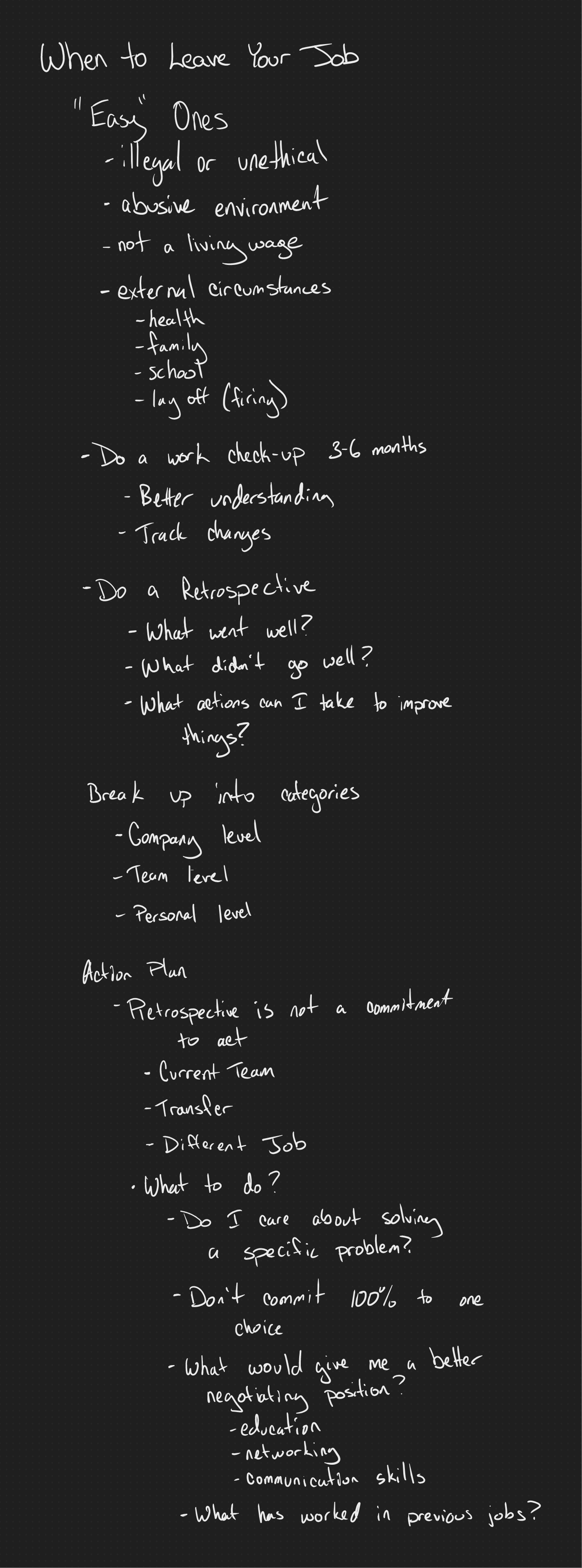
Every six months or so I decide I hate my job, even if I otherwise like it. Instead of putting in notice, I step back for a bit reflect on what is going on and what my next steps should be.
Checking in with yourself every 3-6 months allows you to address problems early and, if you decide to leave, give you plenty of time to prepare and look for another job before it becomes urgent.
If you aren’t in the tech world, you may not know what Agile is. In short, it’s a way of managing projects in a way that allows the project to adjust over time as the needs of the business change. A job can fit nicely into this framework- it is a “project” that grows and changes as time goes on.
There is one particular aspect of agile that we are going to borrow for this check-up: the retrospective. This is a meeting you have with your team to reflect on how the past work period has gone and make some plans on how to improve things in the future. This is something you can do on your own, or you can include your boss, a coach, or your therapist in the process as needed to help you figure out what is going on and create next steps.
There are three questions that you answer during a retrospective:
From there, I also divide this up a bit based on organization structure. This depends on your company structure, but you could do something like “Company”, “Team”, “Personal”. There will be quite a bit of overlap as each effects the other, but the difficulty of making changes will be very different between the groups. An issue with your team is easier to address than one with company culture, but you also may be able to leave a team issue by transfering to a different team. On the flip side, there could be an issue for you with how the company functions, but your team has taken steps to mitigate that problem for that team specifically.
The short answer is that you can include anything and everything that could be affecting your job satisfaction and performance. When answering those first two questions, we aren’t worried about whether or not something actually needs to change, we are just trying to get a better understanding of what is going on. Things like “the office lights are too bright” are just as valid as “job objectives are unclear and confusing.”
One thing to note is that you do want to try to focus on patterns as opposed to individual events or people. Having one bad customer interaction isn’t fun, but how management reacts to those situations are going to give you more insight into the situation.
Once you have the first two sections done, it’s time to go to the hard part- what to do with all that information. This too can be divided up into secotions to help you organize your thoughts.
You can break this section down into different areas as well. At this point you aren’t necessarily commiting to a specific direction, just coming up with things you could do to improve your situation.
At this point, you should have some idea of how your current job is working for you and what you could do to improve it. The final piece is to figure out what you are actually going to do about it.
One mistake to make here would be to go all into one of the three areas from the action items. You may want to focus on one of them, but you can also make small steps into the other two in order to keep your options as open as possible.
You also don’t want to just go for the easiest, which often is leaving your current job. On the surface it may seem like it is simpler to find something that is a better fir than possibly causing conflict by asking for changes in your current job.
Through this process you should have some idea of whether or not trying to improve your current position is possible or worth your effort. If things are in a good place, great! Spend some time on things like professional development where you need to make long term investments in order to get any payoff.
If things aren’t going well, then you’ll have a clearer picture of why. If the issues are organization wide or your role simply isn’t well suited to you, than you may be able to just transfer or modify your role. If these obstacles aren’t going to be overcome that way, then moving on is probably your best choice. You may also choose to do a little bit of job hunting even if you are comfortable- it will help keep your interviewing skills sharp and can give you access to opportunities you didn’t realize were available.